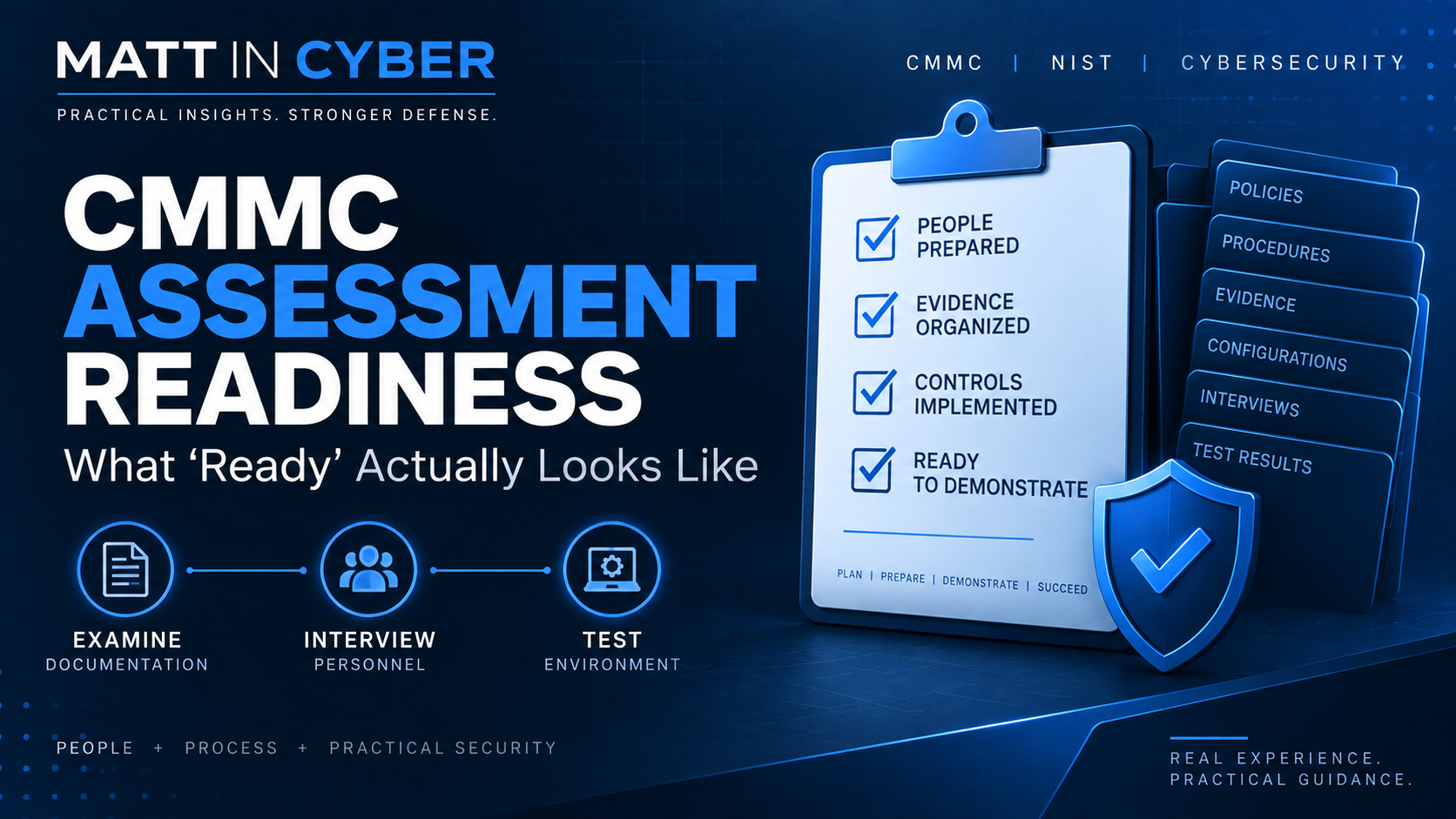
CMMC Assessment Readiness: What “Ready” Actually Looks Like
A CMMC assessment is not simply a review of policies, screenshots, and compliance documents.
Organizations preparing for an assessment need to be able to demonstrate that their cybersecurity requirements are implemented in the environment, understood by the people responsible for them, and supported by evidence that reflects how the organization actually operates.
That distinction is important.
An organization can have a well-written System Security Plan, polished policies, and folders full of evidence and still discover significant problems when someone starts asking questions or testing how the environment actually works.
Assessment readiness is not just having the documentation. It is being prepared to demonstrate the implementation.
CMMC Assessments Look Beyond the Document
The CMMC Level 2 Assessment Guide describes three assessment methods: examine, interview, and test.
Those three words provide a useful way to think about readiness.
Examine means reviewing evidence such as policies, procedures, system security plans, configurations, architectural information, and other artifacts.
Interview means talking with the people responsible for implementing or supporting the security requirements.
Test means exercising mechanisms or activities to determine whether they behave as expected.
This is why preparing for an assessment solely by assembling documents can create a false sense of readiness.
The documentation matters, but the environment and the people operating it matter too.
Your Documentation Should Describe Reality
One of the most important readiness checks is deceptively simple:
Does the documentation describe the environment that actually exists?
Your System Security Plan should not describe the environment you hope to have six months from now. Procedures should not describe processes that employees stopped following last year. Network diagrams should not omit systems simply because updating the diagram is inconvenient.
Documentation becomes useful assessment evidence when it accurately reflects implementation.
Organizations should periodically compare their written documentation against the actual environment and ask:
- Are the systems and boundaries accurate?
- Are responsible roles still correct?
- Do documented procedures match current operations?
- Are security technologies configured the way the documentation says they are?
- Have recent technology or process changes been reflected in the documentation?
A polished document that contradicts the technical environment can create more questions than it answers.
Evidence Should Be Organized Before The Assessment
Finding evidence during an assessment is very different from knowing that evidence probably exists somewhere.
If demonstrating a requirement depends on somebody searching through email, opening multiple ticketing systems, messaging an administrator, or digging through old folders while the assessment team waits, the organization probably has more preparation to do.
Evidence should be mapped to the requirements it supports and reviewed before it is needed.
That does not mean creating enormous folders filled with every screenshot the organization has ever taken. More evidence is not automatically better evidence.
The objective should be relevant, current, understandable evidence that demonstrates implementation.
The CMMC Assessment Guide recognizes assessment objects that can include specifications, mechanisms, activities, and individuals, not merely documents.
Your People Need to Be Ready Too
Technical teams sometimes spend months preparing systems for an assessment while giving much less attention to the people who may participate in interviews.
That can be a mistake.
The individuals responsible for security activities should understand what they do, why they do it, and how their responsibilities relate to the organization’s documented processes.
They do not need memorized compliance scripts.
In fact, rehearsed answers that do not reflect actual operations are unlikely to be particularly useful.
Instead, personnel should be comfortable explaining their normal responsibilities.
An administrator responsible for account management should be able to explain how accounts are created, modified, disabled, and reviewed. Someone responsible for incident response should understand what happens when a potential incident is identified. Personnel responsible for physical access should understand how that access is controlled.
The goal is not to teach employees how to pass an interview.
The goal is to make sure the organization’s documented security processes are also its actual operating processes.
Test Before Someone Else Tests
A useful readiness exercise is to stop asking:
“Do we have this implemented?”
and start asking:
“Can we demonstrate that it works?”
If multifactor authentication is required in a particular scenario, demonstrate it.
If accounts should lock after defined unsuccessful authentication attempts, verify the behavior.
If audit logs are supposed to capture specific events, generate an event and confirm the expected logging occurs.
If access restrictions are based on defined roles, test those restrictions.
This type of validation can uncover problems that documentation reviews alone will never reveal.
Configuration drift, undocumented exceptions, legacy systems, inconsistent administrative practices, and technology changes can all create gaps between intended security and actual security.
Finding those gaps during internal preparation gives the organization an opportunity to address them before they become assessment findings.
Scope Has to Be Understood
Assessment readiness also depends heavily on understanding the environment being assessed.
Organizations should know where CUI is stored, processed, and transmitted and understand the systems, people, facilities, and supporting resources associated with that environment.
DoD publishes dedicated Level 2 scoping guidance alongside its assessment resources because determining assessment scope is an important part of the CMMC process.
An unclear boundary can create downstream problems with nearly everything else: asset inventories, network diagrams, security configurations, evidence collection, and even which personnel need to participate.
Before worrying about whether the evidence folder looks organized, make sure everyone agrees on what environment the evidence is supposed to represent.
A Readiness Review Should Feel Like an Assessment
One of the most useful things an organization can do before an assessment is conduct a structured internal readiness review that resembles the actual assessment process.
Do not simply ask control owners whether requirements are implemented.
Pick representative requirements and walk through them.
Examine the evidence.
Interview the responsible personnel.
Test the technical implementation where appropriate.
Then compare the results against what the SSP, policies, and procedures say should happen.
This approach tends to expose something a checklist does not: disconnects.
A policy may say one thing while an administrator describes another. A diagram may show a system that no longer exists. A procedure may be correct, but nobody knows who is responsible for performing it.
Those disconnects are exactly what organizations want to identify while there is still time to correct them.
The Bottom Line
CMMC assessment readiness is not measured by the size of an evidence repository or the number of policies an organization has written.
A ready organization understands its scope, has implemented the applicable requirements, maintains documentation that reflects reality, has personnel who understand their responsibilities, and can produce meaningful evidence demonstrating how its security controls operate.
The simplest readiness question may be:
If an assessor asked us to show how this works right now, could we?
If the answer is yes, and the documentation, personnel, and technical environment all tell the same story, the organization is moving in the right direction.
Sources & Further Reading
DoD CIO – CMMC Level 2 Assessment Guide
DoD CIO – CMMC Resources & Documentation

3 Comments
Comments are closed.