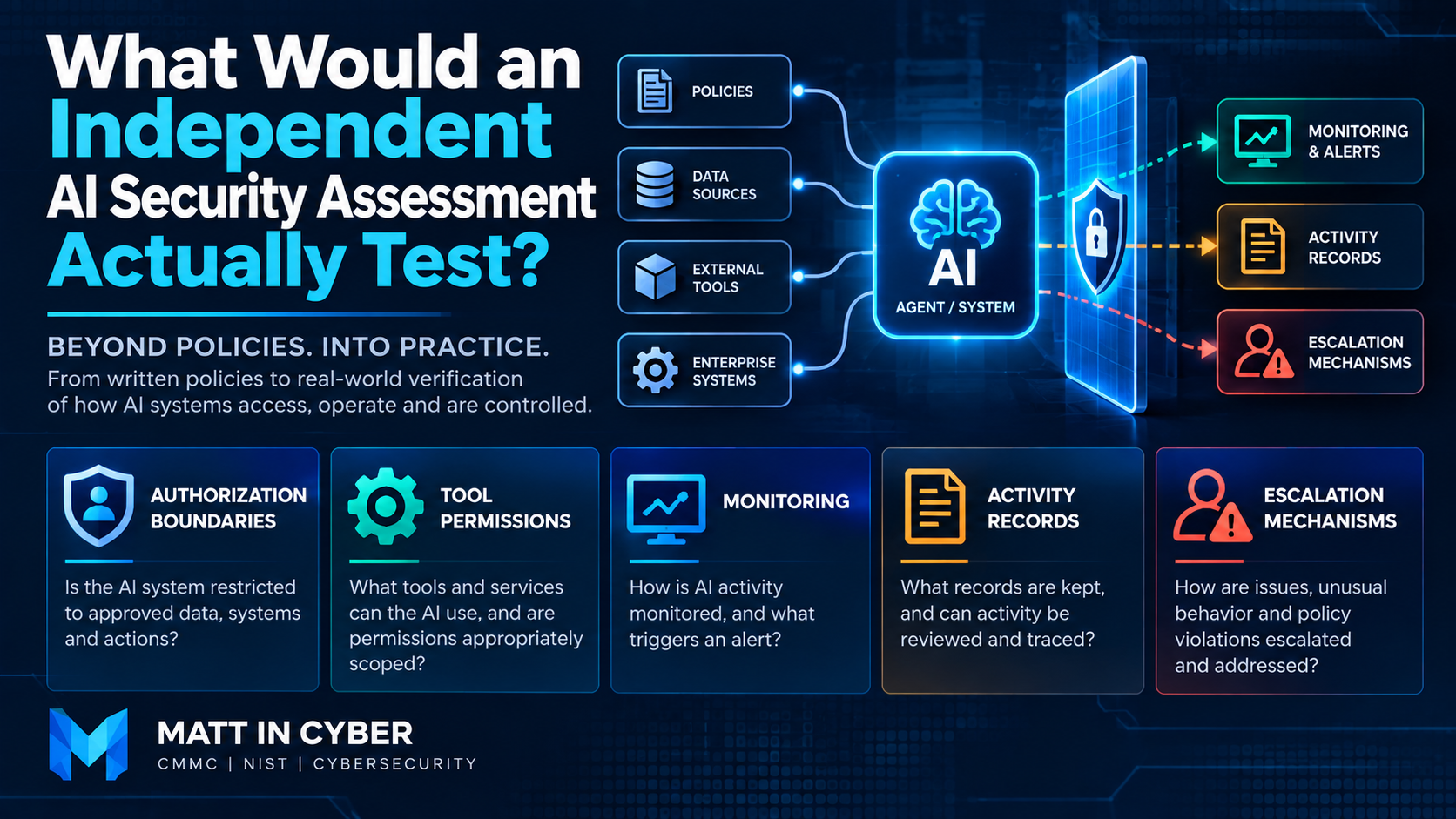
What Would an Independent AI Security Assessment Actually Test?
Organizations are rapidly developing policies for artificial intelligence.
Those policies matter. They can define acceptable use, establish restrictions on sensitive information, assign responsibilities, and set expectations for how employees and systems use AI.
But a policy review answers only one question:
What does the organization say should happen?
A security assessment should ask a different question:
What actually happens?
That distinction becomes increasingly important as AI moves beyond standalone chat interfaces and becomes connected to enterprise data, applications, APIs, cloud services, and tools capable of taking actions.
An independent AI security assessment should therefore go beyond reviewing policies. It should examine whether the technical and operational controls surrounding an AI system actually enforce the organization’s intended security boundaries.
Here are five areas where that distinction becomes especially important.
1. Authorization Boundaries
One of the first questions should be simple:
What is the AI system actually allowed to access?
Consider an internal AI assistant connected to corporate information. An organization might have a policy stating that employees should access only information appropriate to their roles.
That does not demonstrate that the AI system enforces the same restriction.
An assessment should examine the authorization boundaries surrounding the system.
Can one user cause the AI to retrieve information belonging to another department?
Does the AI inherit the permissions of the requesting user?
Does it operate using a broader service account?
What happens when someone asks the system for information outside their normal access?
The objective is not merely to confirm that access-control requirements exist on paper. It is to determine whether those boundaries continue to function when AI becomes another pathway to the information.
This is particularly important because modern AI systems may operate within larger software environments rather than as isolated models. NIST’s adversarial machine learning work specifically recognizes AI systems that interact with private data and tools capable of producing real-world consequences.
2. Tool Permissions
AI agents introduce another security question:
What can the system actually do?
An AI assistant that summarizes documents presents one type of risk.
An AI agent that can send email, modify records, execute code, create cloud resources, access databases, or interact with business applications presents something very different.
The security assessment therefore needs to understand the tools available to the AI and the permissions granted to those tools.
An assessor might examine whether tool access follows least-privilege principles, whether sensitive actions require additional authorization, whether the AI can chain several individually permitted actions into an unintended result, and whether permissions are separated appropriately between users and systems.
The difference is important.
A policy might say:
“AI systems must not perform unauthorized actions.”
Testing asks:
What prevents them from doing so?
OWASP’s recent Agent Control Standard reflects this broader concern, emphasizing the need for organizations to understand what agents can access, what they did, and how their behavior can be controlled at runtime.
3. Monitoring
Security controls eventually fail.
Someone finds an unexpected workflow. A permission is configured incorrectly. A tool behaves differently after an update. A user intentionally tries to bypass a restriction.
The next question becomes:
Would anyone know?
An AI security assessment should examine whether meaningful activity is monitored and whether potentially dangerous behavior can generate alerts.
That could include unusual tool invocation, repeated attempts to perform restricted actions, elevated privilege use, abnormal access patterns, or unexpected increases in high-risk activity.
This is not simply a question of whether a monitoring product exists.
The assessment should determine whether the organization has visibility into the behavior that actually matters for the AI system being evaluated.
OWASP’s current AI Agent Security guidance recommends monitoring agent decisions, tool calls, outcomes, approval behavior, privilege use, and other security-relevant activity.
4. Activity Records
Monitoring tells an organization that something may be happening.
Activity records help explain what happened afterward.
Suppose an AI agent performs an unexpected action.
Can the organization determine which user initiated the interaction?
What request was made?
Which tool did the AI invoke?
What authorization decision occurred?
Was human approval required?
What action ultimately executed?
Was the action successful?
Without adequate records, investigating AI activity can quickly become guesswork.
An assessment should therefore examine whether significant AI interactions and actions leave enough evidence to reconstruct security-relevant events.
This becomes especially important as AI systems gain greater autonomy.
The more an AI system can do, the more important accountability becomes.
OWASP’s agent-security guidance similarly calls for audit trails and structured records around high-risk actions, including authorization and approval information.
5. Escalation Mechanisms
Finally, an organization needs to answer:
What happens when the AI does something unexpected?
Policies often describe prohibited behavior. Mature security operations also establish mechanisms for responding when something goes wrong.
An assessment might examine what happens when monitoring detects suspicious AI behavior, a user reports an unexpected result, a tool attempts a restricted action, sensitive information appears where it should not, or the organization discovers that an AI integration has been misconfigured.
Who receives the alert?
Who has authority to disable the integration?
Can tool access be revoked quickly?
Can credentials or tokens be invalidated?
Is there a defined process for investigating the event?
Does the incident-response process even account for AI-enabled systems?
The purpose is not to predict every possible AI failure.
It is to determine whether the organization can recognize, contain, investigate, and respond when the system behaves outside expected boundaries.
Policy Review and Security Testing Are Not the Same Thing
None of this means policy review is unimportant.
Policies establish governance expectations and provide the foundation for accountability.
But policies and technical controls answer different questions.
A policy may state that sensitive information cannot be entered into an unauthorized AI service.
A technical assessment asks whether controls actually prevent or detect that activity.
A policy may require approval before an AI agent performs a sensitive action.
Testing asks whether that approval can be bypassed.
A policy may require AI activity to be logged.
Testing asks whether the records actually contain enough information to reconstruct what occurred.
This is the same fundamental distinction cybersecurity professionals encounter elsewhere:
Documentation describes the intended state. Testing provides evidence about the implemented state.
What About Prompt Injection and Adversarial Testing?
Those belong in the conversation too.
NIST’s current adversarial machine learning taxonomy addresses threats including misuse, evasion, poisoning, privacy attacks, and other attacks against predictive and generative AI systems. NIST Computer Security Resource Center
An AI security assessment may therefore include adversarial testing appropriate to the system being evaluated.
But prompt injection alone should not become synonymous with AI security testing.
A system could resist a collection of clever prompts while still having excessive permissions, inadequate logging, poor authorization boundaries, or no meaningful incident-response process.
Likewise, a model could behave appropriately during a demonstration while the surrounding architecture exposes sensitive data through poorly designed integrations.
The model is only one component of the security problem.
The Assessment Should Follow the Risk
There probably should not be one identical test plan for every AI system.
A public chatbot answering questions from published website content presents a different risk profile from an internal AI assistant connected to corporate documents.
An agent capable of modifying cloud infrastructure presents another level of risk entirely.
The scope and depth of an independent assessment should reflect what the AI system can access, what actions it can perform, what information it processes, and what consequences could result if its controls fail.
That is consistent with the broader risk-based approach reflected in NIST’s AI security work. NIST describes AI security in terms of threats, potential consequences, attacker capabilities, system properties, and the context in which AI is deployed.
The Bottom Line
An independent AI security assessment should not stop at asking whether an organization has an AI policy.
It should examine whether the controls surrounding AI systems actually work.
Can the AI cross authorization boundaries?
What tools can it use?
What permissions do those tools have?
Can unusual activity be detected?
Can significant actions be reconstructed afterward?
What happens when something goes wrong?
Those questions move the conversation from AI governance on paper to AI security in practice.
As AI systems gain access to more enterprise data and become capable of taking more actions, that distinction will become increasingly important.
As always, for additional information on assessment readiness, check out my article here!
Sources & Further Reading
NIST AI 100-2e2025: Adversarial Machine Learning
NIST AI RMF Generative AI Profile
OWASP Agent Control Standard
OWASP AI Agent Security Cheat Sheet